
22 de October 2026 — by ETIC_Algarve
Pierre Schaeffer: From “musique concrète” to today’s music production
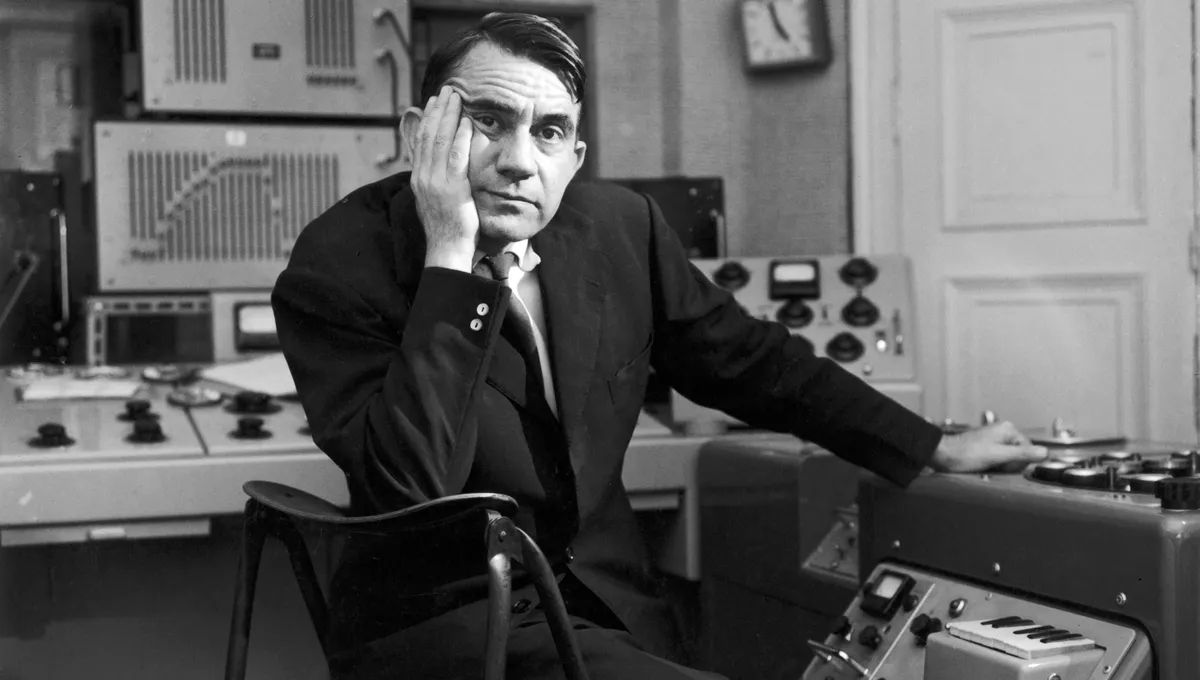
If we go back to the late 1940s, long before the first digital sampler was
invented, and analyze the innovative profile of Pierre Schaeffer, we can observe the relevance that this engineer, composer, researcher, and radio man had for the way we currently listen to, create, and engage with new sonorities.
During this period, Schaeffer was one of the central figures in the development of what he called musique concrète – a new approach to music creation, where the major difference was right at the starting point: instead of starting music from a score or an instrument, the idea was to start from a sound that had already been recorded.
Today, this logic may seem perfectly natural to us, but at that time, it represented a profound shift in how music was thought about and composed. In traditional music, the logic was, in many cases, quite linear – first you composed, then you performed, and finally you recorded the result. Schaeffer decided to invert this process – The recording became the raw material; sound could be captured, selected, cut, looped, reversed, sped up, slowed down, and reorganized until it acquired a new musical function.

Sound as an object
Schaeffer also introduced us to a new way of listening, based on perceiving sound as an object independent of its original source, highlighting its individual characteristics – texture, shape, duration, movement, density, or timbre. Reduced listening awakened us to the ability to hear sound beyond what produced it – A metallic impact can become a percussive element; A voice can be processed until it functions as a textural element; Ambient noise can serve as a rhythmic foundation; A seemingly banal sound can become a central element of a composition.
This selective approach to listening has become extremely relevant nowadays for anyone working in music production, requiring the producer not only to work with tools, but also to rely on their critical listening skills – this is, in my view, an essential point to highlight when teaching this subject.
Technology has changed, the principle remains
To achieve these transformations, Schaeffer used turntables – to play back and manipulate sound – magnetic tape Recorders/Players – to play back, record, and edit excerpts – as well as some analog sound processing units. Editing was done physically, cutting and splicing expensive magnetic tape, which required time, precision, and very deliberate, assertive decisions that today are performed virtually instantaneously – in production software, among an infinity of other possibilities, you can cut, duplicate, reverse, or stretch a sound in just a few seconds.
It is worth noting, however, that today’s technical ease does not eradicate the need to make good decisions; on the contrary, it makes that need even greater. That is, having access to hundreds of plugins and thousands of samples does not necessarily mean producing better, as the most important thing remains knowing what we intend to do with the sound.
There is an idea I consider particularly useful from a pedagogical standpoint: before
choosing a plugin to download and install, try choosing first the transformation you are looking to achieve, or a concrete goal for the sound – after all, it must be the object of our critical listening. I consider this an excellent strategy to prevent technology from replacing creative intention.

The connection to teaching at ETIC_Algarve
This relationship between listening, technique, and creativity is very present in the Sound and Music courses at ETIC_Algarve, such as the Music Creation, Production and Sound Techniques course, and the Electronic Music Production and Creation course, in which students work on areas like digital audio, studio techniques, editing, processing and mixing, sampling, synthesis, or sound for picture.
It is clear that many of the skills we teach today have a direct connection to the legacy of innovations introduced by the visionary Pierre Schaeffer.
Teaching that sound does not have to be merely something to record, but also something that can be
manipulated, transformed, and creatively reorganized, is for me the most interesting part of exploring this subject with students.
And it is not just about getting to know a key figure in the history of electroacoustic music, but also about understanding the continuity that exists between the studio experiments of the mid-20th century and what we do today through Ableton Live, Pro Tools, synthesizers, MIDI controllers, or digital processing tools.
What can future professionals take away from this approach?
If from a technical standpoint Schaeffer left us methods, on the other hand, from a creative standpoint, he left us an attitude – The ability to listen attentively; The willingness to experiment; The understanding that a sound can fulfill a function different from the one it originally seemed to have; And, above all, the idea that technology must be at the service of an intention.
I think this is a particularly relevant message for anyone starting a
journey in music production and sound. Learning to use software is important, and knowing acoustics, recording, mixing, and mastering is essential. But developing good listening skills and a methodology of experimentation is what allows you to turn technical knowledge into creative work.
Ultimately, that is what continues to keep Pierre Schaeffer relevant. The tools have changed
radically, but the question remains: What can this sound become?

Written by: Pedro Lobo
Sound & Music Trainer | ETIC_Algarve
Editorial note:
The opinions expressed in this article are the sole responsibility of the author and do not necessarily reflect the position of ETIC_Algarve | GIZ, LDA.